

April illustrated how quickly global markets can pivot when geopolitical risks appear to stabilise, even if underlying macroeconomic uncertainties remain unresolved. This month’s newsletter explores the key market developments during the period, together with the current economic and investment landscape.
Before the war, the global economy was already in a late-cycle phase, with inflation trending lower and dominant markets buoyed by the AI theme and trading at extreme valuations. These conditions remain unchanged, but both the International Monetary Fund (IMF) and the Organisation for Economic Co-operation and Development (OECD) have warned that a prolonged energy shock would mean weaker growth and higher inflation.
In this kind of environment, staying disciplined and adaptable matters most. When the tempo shifts, long-term outcomes are shaped not by reacting to every move, but by understanding the underlying forces driving the change.
GLOBAL MARKET UPDATE
The S&P 500 rose approximately 10.5% in USD terms in April, marking one of its strongest monthly gains since late 2020, as markets rebounded sharply from the March selloff. The rally was driven by an improvement in risk sentiment following a tentative Middle East ceasefire, resilient corporate earnings, and renewed strength in mega-cap growth and AI-linked sectors, particularly technology and communication services.
Meanwhile, the Russell 2000 gained approximately 12% in USD terms over the month, with small-cap equities participating in the broader market rebound amid improving financial conditions and stronger risk appetite. Chinese equities delivered a more modest return, rising approximately 3.5% in USD terms in April, but continued to lag broader emerging market peers.
Economic resilience
 In April, US macroeconomic data pointed to a moderating yet still resilient economy. The US added 115,000 jobs during the month, while the unemployment rate remained unchanged at 4.3%, suggesting a labour market that continues to stabilise, albeit with softer hiring momentum compared with previous months.
Wage growth also eased, indicating some cooling in labour market tightness within a low-hire, low-fire environment. Market expectations pointed to a potential rise in inflation in April, reflecting ongoing energy price pressures, although underlying trends in core inflation components were expected to remain relatively contained.
Unchanged rates
The Federal Reserve held rates unchanged at its April policy meeting, maintaining a data-dependent stance and reiterating that future policy adjustments would depend on clearer evidence of sustained disinflation alongside stable economic growth. The decision was notably more divided than in previous meetings, with an 8–4 vote split – the highest level of dissent since 1992 – as policymakers expressed differing views on the appropriate policy path and forward guidance. While one member dissented in favour of an immediate rate cut, three others opposed aspects of the policy statement, highlighting growing divergence within the Committee. In addition, Chair Jerome Powell confirmed his intention to remain on the Federal Reserve’s Board of Governors for a period after his term as Chair concludes in May, citing the importance of maintaining institutional stability amid ongoing external pressures.
LOCAL MARKET UPDATE
South African financial markets delivered more constructive performance over the month. The FTSE/JSE All Share Index rose by approximately 1.6% in ZAR terms for April, recovering modestly following the sharp drawdown in March as global risk sentiment improved, the rand strengthened, and domestic sectors outperformed.
Listed property
Listed property also rebounded, with the FTSE/JSE SA Listed Property Index rising by approximately 5.9% in ZAR terms over the month, as easing bond yields, improved investor sentiment and renewed institutional demand supported a recovery following the prior month’s selloff.
The main contributors to performance were Hammerson (+11.4%), Fortress B (+10.0%), Dipula (+8.3%), Vukile (+8.0%), Octodec (+7.9%) and Sirius Real Estate (+7.9%). Offshore-exposed counters were partly supported by currency movements, as the rand weakened 1.25% against the Pound, boosting the rand returns of UK-listed property names.
 Looking ahead, income generation is expected to remain the key driver of returns, though risks remain. Stronger counters should continue to benefit from contractual escalations, improved vacancies, cost control and easing finance-cost pressure. However, higher inflation or policy rates remaining restrictive for longer could slow the pace of improvement. While the impact on leasing outcomes is likely to emerge with a lag, pressure may be visible sooner in retail trading densities and tenant turnover as higher inflation and fuel costs weigh on disposable income, particularly in centres with greater exposure to discretionary spending. As a result, companies with resilient tenant demand, defensive retail formats, disciplined capital allocation and clear earnings visibility are likely to continue differentiating themselves.
Bonds
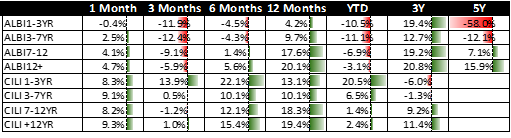
The South African bond market remained volatile over April, with local fixed income continuing to face pressure from elevated global yields and persistent inflation uncertainty. While domestic inflation data remained relatively benign, headline consumer inflation rose slightly to 3.2% year-on-year in March (from 3.0% in Feb), suggesting some early passthrough from higher fuel prices. Despite this, inflation remained within the lower end of the SARB’s target range, providing some support to real yields, although the market continued to price in upside risks to inflation given the evolving global backdrop.
Summary of asset class returns in April:
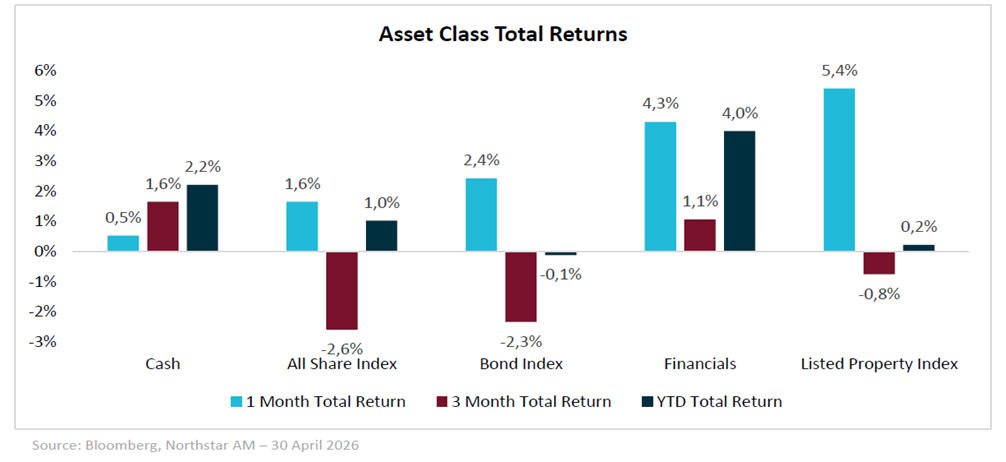
Attention now shifts to the upcoming SARB meeting in May. Policymakers are expected to maintain a cautious stance, balancing still‑contained domestic inflation against rising external risks, including elevated global interest rates and persistent energy price volatility. While the current policy rate remains at 6.75%, market expectations for easing have been pushed further out, with the SARB likely to seek greater clarity on the inflation trajectory and global conditions before signalling any adjustment to the policy path.
SECTOR RETURNS
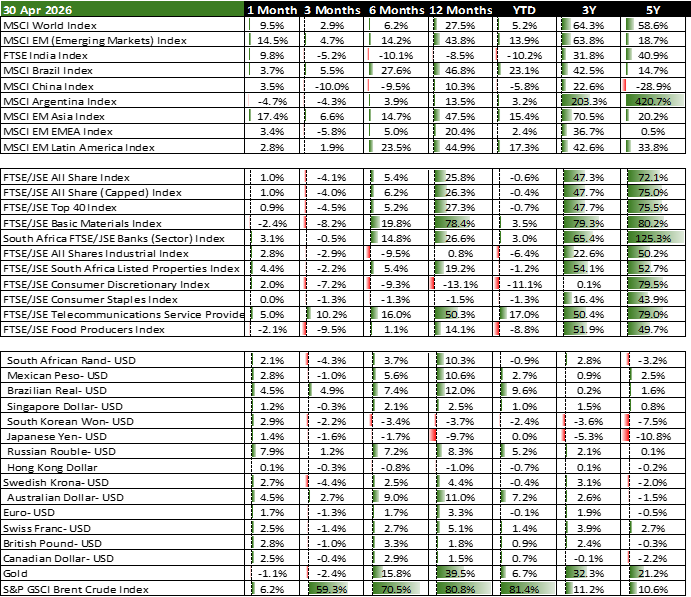
 Global equities rebounded strongly in April, recovering the losses recorded in March despite heightened geopolitical tensions and renewed concerns around inflation and global trade. The MSCI World Index returned 9.6% for the month, supported by broad-based strength across most major regions. Emerging markets outperformed meaningfully, with the MSCI Emerging Markets Index rising 14.7%, led by a sharp recovery in Asian equities. Korea and Taiwan were standout performers as investor sentiment improved toward semiconductor and AI-related sectors. Commodity markets were also firmer during the month, with gains in energy and industrial metals reflecting concerns around supply disruption and elevated geopolitical risk.
South African equities participated in the rebound, although gains were more muted relative to broader emerging markets. In rand terms, the JSE Capped ALSI rose 1.6% in April, supported primarily by financials and industrials. Banks and selected industrial counters recovered following weakness in March, while performance within resources was mixed. Industrial metals and diversified miners delivered solid gains, assisted by strength in Anglo American and BHP, although precious metal producers remained under pressure after the sharp correction seen in the prior month. The divergence across the resources complex highlights the increasingly selective nature of market leadership, with investors favouring cyclical and economically sensitive exposures over defensive commodity trades.
ASSET CLASS VIEWS
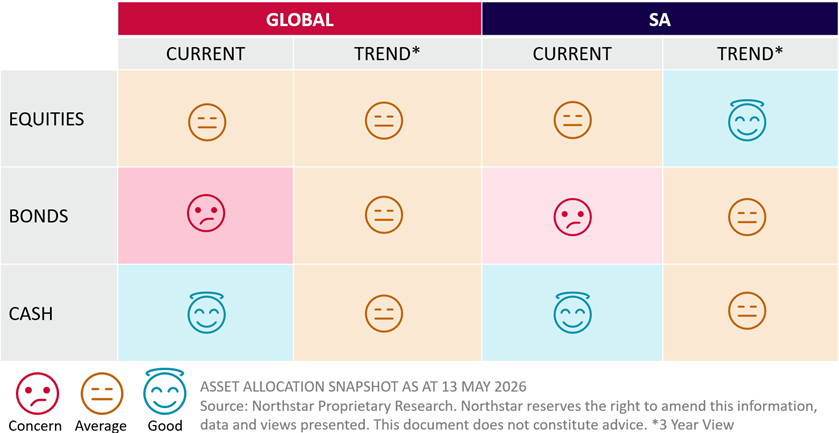
Summary:
Details:
Global Equities
Current (Average)
April saw sector leadership return to the cyclical and AI led theme that led prior to the March sell-off. Strong earnings in AI-adjacent sectors reinforced the market’s confidence in the sustainability of long-term demand trends, evident in the MSCI World Semis Index returning 27.4% in April. Information Technology and Communication Services led returns, while Industrials and Consumer Discretionary performed well as confidence in near‑term growth stabilised despite energy price uncertainty. Energy gave back some of its recent outperformance, while Health Care remained a relative laggard.
Trend (Average)
At an index level, valuations and earnings growth expectations remain elevated despite the recent disruption to global energy markets and supply chains. This growth is skewed to cyclical areas such as semiconductors, materials, and energy, raising questions around the long-term durability of this earnings base. That said, the current environment continues to present selective opportunities for bottom‑up investors. Capital has been heavily concentrated in a narrow set of growth themes, leaving several less favoured segments of the market trading at more reasonable valuations relative to their long‑term earnings potential.
SA Equities
Current (Average)
The JSE was broadly flat in April, gaining just 1% and lagging emerging markets, which advanced 4.5% over the same period. Sector performance was mixed. Telecommunications led with a 5% gain, supported by strong growth from MTN and Vodacom across sub-Saharan Africa. Listed Property (+4.4%) and Banks (+3.1%) also advanced. Basic Materials was the notable laggard, declining 2.4% as the gold price retreated late in the month. The broader backdrop remains uncertain. With no clear resolution to the Middle East conflict in sight, the risk of sustained oil supply constraints is keeping inflation expectations elevated. This has direct implications for interest rates, and by extension, for rate-sensitive sectors, particularly Banks, Listed Property, and consumer-facing retailers where demand is already under pressure.
Trend (Good)
Our valuation work supports a constructive view on local equities, with opportunity skewed toward more cyclical areas. We see upside in selected retailers, rand hedges, and banks, though we remain mindful of downside risks should the Middle East conflict prove prolonged. Gold and PGM counters appear broadly fairly valued at current levels. Medium term, we remain constructive on the domestic macro recovery while remaining mindful of risk posed by the current geopolitical uncertainty.
Global Bonds
Current (Concern)
Elevated geopolitical risk continues as of the Strait of Hormuz remains shut and no inroads have been made through multiple rounds of negotiations. With the oil price elevated, the trajectory of global inflation and path of interest rates have been upended. Bonds have sold off and could continue to come under pressure the longer the supply of oil remains offline.
Trend (Average)
Over the longer term, the outlook remains largely intact: Sticky inflation, stable labour dynamics, rising growth forecasts and questions over Fed independence in 2026, should keep yields elevated with the long-end most vulnerable to these pressures. A prolonged war in the Middle East will keep oil prices elevated and inflation concerns front of mind, causing volatility for yields at the short-end. The longer the conflict lasts, the more pronounced the feed through effects of a high oil price will be on the physical economy.
SA Bonds
Current (Concern)
Local bonds remained on shaky ground in April as the global risk off environment continued despite a fragile ceasefire in the Middle East. Front-end bonds are seeing most of the pain as the market reassess the interest rate path in light of a prolonged oil price shock. Growing uncertainty and rising inflation risks are negative for local bonds over the short term and may led to evidence of demand destruction, which would test medium term economic assumptions.
Trend (Average)
Despite the recent sell off in local bonds, positive structural elements remain in place. Fiscal dynamics have improved and sovereign finances appear to be robust enough to weather global risks. The reform outlook is gaining credibility and could necessitate multiple rating upgrades from the ratings agencies over the medium term. The meaningful pull back in yields has provided for some opportunity at the front end of the curve, but longer out the curve appears fairly valued on our metrics, moving back from overstretch levels that we saw in February.
Global Cash
Current (Good)
Over the near term, cash is the area providing the best protection against volatility. One can still generate a real return from cash, and any inflationary impulses would be combated with interest rate hikes from central banks, making cash more appealing on relative basis.
Trend (Average)
On a three-year horizon, our valuation points to better opportunities in bonds across the curve versus what could be received for cash. However, volatility is likely to persist over the medium-term with debates about labour market weakness and rising inflation pressures creating uncertainty for where interest rates may settle.
SA Cash
Current (Good)
The materialisation of geopolitical risk will likely keep the SARB cautious and may even lead to rate hikes in the near term. Further, real rates remain elevated as the SARB attempts to drive inflation expectations lower and maintain credibility. Current cash rates on offer are well above the inflation rate, therefore investors can earn a healthy real return without taking on risk.
Trend (Average)
As inflation expectations move credibly lower over the medium, the SARB will become less restrictive and real rates will narrow, causing cash to become less competitive relative to other assets. It remains to be seen whether current geopolitical risks will be prolonged and to what extent the consequences stemming from elevated oil prices will filter into our longer term interest rate assumptions and cash valuations.
PLEXUS WEALTH FUND PERFORMANCE
Given the volatile nature of markets, how did the Plexus Wealth range of funds feature up to 30 April 2026?
Plexus Wealth BCI Conservative Fund:
+3.05% for April
+0.09% for the year to date
+14.15% over the past 12 months.
Plexus Wealth BCI Balanced Fund:
+3.77% for April
-0.48% for the year to date
+13.36% over the past 12 months.
Plexus Wealth BCI Property Fund:
+5.35% for April
+1.29% for the year to date (ranked 3rd in the country)
+32.44% over the past 12 months (ranked 4th out of 39 peers)
For comparative purposes, the JSE All Share Index was up 1% for the month, down 0.6% year-to-date, and down 4.1% over the past three months.
GLOBAL MARKET SNAPSHOT
Below is a summary of the performance of selected indices and changes in currency exchange rates:
While markets may continue to respond to shifting economic and geopolitical developments, we maintain a disciplined investment approach grounded in long-term fundamentals. Periods such as these often create both challenges and opportunities, reinforcing the importance of patience and diversification.
GOT A QUESTION?
If you would like to discuss how current market conditions may affect your portfolio, we will be happy to chat with you. Please contact your Plexus Wealth financial advisor to arrange a meeting.