

Oil above USD 100, then back into the USD 80s, all within a single month. July was a reminder of how quickly global markets can move when geopolitics enters the picture. In our latest report, we unpack what drove the volatility, how South African markets held their ground, and where we still see value.
GLOBAL MARKET UPDATE
 Global equity returns were relatively subdued in July, with the MSCI World Index gaining 0.5% in US dollar terms. Beneath the headline index return, however, there was significant dispersion across sectors, regions and investment styles.
Energy was the strongest-performing sector, rising 12.7% as US-Iran hostilities re-escalated and the ceasefire framework agreed in June began to unravel amid renewed disagreement over the Strait of Hormuz. Renewed hostilities eroded the interim Memorandum of Understanding, which had initially sought to end the conflict and reopen the Strait to commercial shipping. The deterioration in the geopolitical backdrop drove renewed volatility in energy markets, with oil rising 20.5% during July, reversing much of its 19.9% decline in June.
At the other end of the spectrum, Information Technology declined 4.1%, although the headline sector return masked a significant rotation within technology itself. Semiconductors fell 13.2%, while Software & Services gained 12.3%, representing a sharp reversal of the leadership seen earlier in the year. This was particularly notable given the strength of semiconductor and AI-related companies during the second quarter, while software had previously been one of the weaker areas of the market.
Emerging markets
Emerging markets declined 3.1%, underperforming developed markets, with Taiwan (-5.3%) and South Korea (-17.1%) among the largest detractors as semiconductor-related equities pulled back. Importantly, this followed an exceptional first half of the year: South Korea and Taiwan had gained 88% and 49%, respectively, during the second quarter alone, driven largely by demand for semiconductor and AI infrastructure companies. July therefore represented, at least in part, a reversal of some of the market’s strongest year-to-date trends.
This reversal was also evident at the style-factor level. Momentum was the weakest-performing style, falling 9.3%, while Value led with a 3.6% gain. Quality (-0.7%) and Growth (-2.5%) also declined. Taken together, July was less notable for the modest movement in the overall index than for the sharp rotation away from many of the areas that had led markets earlier in the year and towards previously lagging sectors and styles.
In July, US macroeconomic data pointed to a further weakening in labour demand, with nonfarm payrolls declining by 23,000 following a downwardly revised increase of just 20,000 in June. The unemployment rate nevertheless edged lower from 4.2% to 4.1%, while labour-force participation remained subdued at 61.4%, reinforcing signs of a softer labour market. Wage growth also moderated, with average hourly earnings little changed over the month and rising 3.2% year-on-year. Inflation pressures continued to moderate in July, with headline CPI increasing by a modest 0.1% month-on-month while easing to 3.4% year-on-year from 3.5% in June. Core inflation rose 0.2% over the month but slowed to 2.5% year-on-year from 2.6%, suggesting that underlying price pressures remained relatively contained. Lower energy prices provided some relief, declining 1.5% during the month, while shelter costs accounted for the majority of the increase in headline inflation.
Inflation and rates
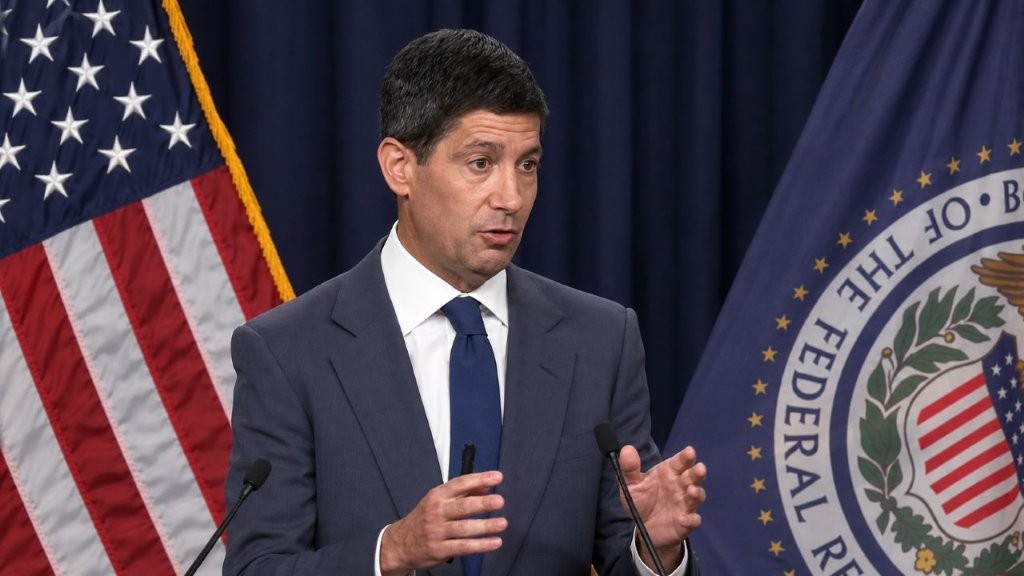
Federal Reserve Chair Kevin Warsh
In July, the Federal Reserve maintained the federal funds target range at 3.50%–3.75%, with the decision passing by a 9–3 vote as three members favoured a 25-basis-point increase. Chair Kevin Warsh emphasised that the US economy remained resilient, but reiterated that inflation was still elevated relative to the Fed’s 2% objective, with energy-related supply shocks contributing to price pressures.
Elsewhere, the European Central Bank kept its three key policy rates unchanged following June’s increase, leaving the deposit facility rate at 2.25%, while maintaining a data-dependent stance amid uncertainty surrounding energy prices and their potential second-round inflation effects. The Bank of England also held its Bank Rate at 3.75% by a 6–3 majority, although three members voted for a 25-basis-point increase, reflecting continued concern that elevated energy prices could generate more persistent inflationary pressures despite signs of underlying disinflation.
LOCAL MARKET UPDATE
South African equities recovered in July, with the FTSE/JSE All Share Index gaining approximately 1.2% in ZAR terms, reversing part of June’s decline. Resource shares led the recovery, rising around 2.1% as stronger oil and platinum prices supported energy and platinum producers, while gains in Naspers and Prosus provided additional support. Financials also advanced, while industrials recorded more modest gains; telecommunications and gold shares were among the weaker areas of the market.
South African bonds weakened in July, with the FTSE/JSE All Bond Index declining approximately 1.4% as government bond yields moved higher and the rand softened. The 10-year government bond yield rose by roughly 30 basis points to around 8.7%–8.8%, reflecting renewed inflation concerns, higher oil prices and some disappointment following the SARB’s decision to leave the repo rate unchanged at 7.0%. Headline inflation accelerated to 5.0% year-on-year in June from 4.5% in May, while core inflation increased to 4.1%, adding to concerns over the domestic inflation outlook. Despite the weaker month, South African bonds continued to offer comparatively attractive nominal and real yields.
 Local inflation
In July, Governor Lesetja Kganyago reiterated the SARB’s commitment to returning inflation to its 3% target, noting that the recent oil shock had pushed headline inflation to 5.0% in June. He emphasised that the May rate increase to 7.00% had created room for the MPC to hold rates unchanged in July, while maintaining a sufficiently restrictive policy stance. Kganyago cautioned that elevated services inflation and rising inflation expectations remained key risks, and stressed that the SARB would continue to act as necessary to prevent the current supply shock from becoming embedded in broader price-setting behaviour.
SA Listed Property was the best-performing asset class in July, delivering a total return of +2.3%, ahead of the JSE Capped ALSI at +1.2%, while the All Bond Index declined 1.4%. The sector remained supported by expectations of lower medium-term interest rates and funding costs. While the SARB kept rates unchanged, its messaging reinforced expectations that the cutting cycle should resume, providing a tailwind to distributable earnings growth. Despite recent gains, SA REIT valuations remain attractive, although elevated fuel costs pose a risk to consumer-facing landlords, particularly discretionary retail.
SECTOR RETURNS
 Global equities delivered a more mixed performance in July after June’s pullback. The MSCI World Index returned 0.5% for the month in US dollar terms, while emerging markets lagged with a 3.0% decline. Regional performance diverged sharply, with Latin America up 4.9% and EMEA up 1.4%, offset by weakness across Asia, down 4.2%, as Korea led the region lower with a 17.1% slide. Brent crude was the standout story of the month, spiking from around USD 70 a barrel to above USD 100 as renewed Iran conflict hostilities disrupted shipping through the Strait of Hormuz, before easing back to the mid-USD 80s by month end. The resulting spike in energy prices pushed government bond yields higher across developed markets, even as most central banks held rates steady.
South African equities held up better than their emerging market peers despite a weaker MSCI South Africa Index, down 0.3% in dollar terms. In rand terms, the JSE Capped ALSI returned 1.2% for the month, with every major sector in positive territory. Resources led the way, up 2.1%, followed by Financials at 1.3% and Industrials at 0.3%. Locally, the SARB unexpectedly held its policy rate steady despite inflation rising to 5.0% in June, choosing to view much of the shock as temporary rather than structural.
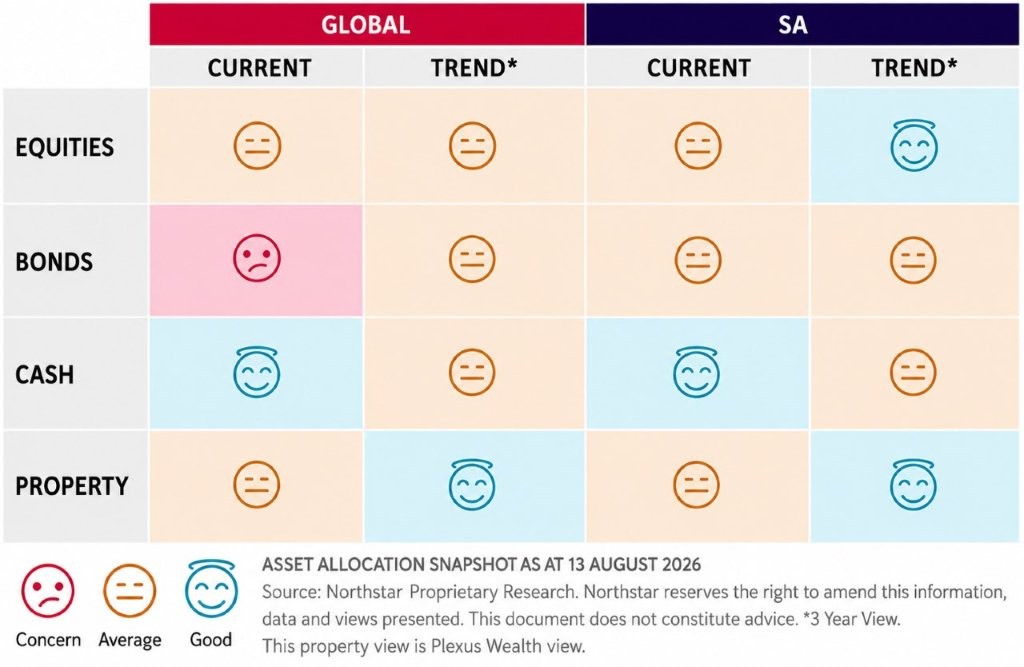
ASSET ALLOCATION VIEWS
DETAILS
Global Equities
Current (Average)
July showed early signs of a broadening in market leadership, particularly away from the semiconductor and memory names that had been among the strongest performers earlier in the year. Semiconductors declined 13.2% during the month, while Software & Services gained 12.3%, representing a sharp reversal in relative performance within the technology sector. More broadly, there were signs of capital rotating away from a narrow group of high-growth themes and towards high-quality businesses trading at more attractive valuations relative to their intrinsic value. This was reflected in the improved relative performance of traditionally more defensive areas of the market, with Consumer Staples gaining 1.8% and Healthcare 2.4%. Financials were also particularly strong, rising 6.5%, supported by robust earnings and a resilient macroeconomic backdrop.
Trend (Average)
Following an exceptionally strong second quarter for global equity returns were considerably more subdued in July. This appeared to reflect a period of consolidation, as companies continued to report healthy earnings but, in many cases, strong fundamental outcomes were already reflected in share prices and elevated expectations. Against this backdrop, July represented a partial reversal of the AI and semiconductor leadership that had dominated markets earlier in the year. Investors increasingly began to question the pace of AI monetisation and whether the exceptionally strong earnings revision cycle particularly across memory-related semiconductor companies could continue at the same rate. At the same time, leadership broadened into areas that had previously lagged. While it remains too early to call a sustained change in market leadership, July provided some evidence that returns may be beginning to broaden beyond the narrow group of companies and themes that drove much of the market’s gains earlier in the year.
SA Equities
Current (Average)
Higher energy prices pushed government bond yields higher across developed markets, with most central banks keeping rates unchanged while maintaining a cautious tone. In South Africa, the SARB unexpectedly held rates steady despite inflation rising to 5.0% in June, citing weak economic growth and viewing much of the inflation shock as temporary rather than structural. Against a volatile global backdrop, South African equities proved relatively resilient, with the JSE Capped ALSI returning +1.2% in rand terms and all major sectors advancing: Resources +2.1%, Financials +1.3% and Industrials +0.3%. In US dollar terms, the MSCI South Africa Index declined 0.3%, compared with a +0.5% return from the MSCI World Index and a 3.0% decline in emerging markets. Emerging market weakness was concentrated in Asia (-4.2%), particularly Korea (-17.1%), which more than offset gains in Latin America (+4.9%) and EMEA (+1.4%).
Trend (Good)
We remain overweight domestic SA Inc. equities on a risk-adjusted basis, with our valuation work supporting selective exposure to Banks, Industrials and Retailers. Against a backdrop of gradual macroeconomic improvement and easing geopolitical tensions, we continue to see attractive medium-term return potential across these sectors. Within commodities, the recent pullback in Gold and PGM counters has resulted in a more balanced risk-reward profile, with selective opportunities beginning to emerge, particularly within the PGM sector.
Global Bonds
Current (Concern)
US and Iran are still exchanging fire and ship traffic through Hormuz is limited, with no deal currently in sight. With the oil price volatility, the trajectory of global inflation and path of interest rates remain uncertain. Bonds have sold off and could continue to come under pressure the longer the supply of oil remains hindered. Changes in the Fed’s communication strategy has also led to some confusion among market participants and upward pressure on yields.
Trend (Average)
Over the longer term, the outlook remains largely intact: Sticky inflation, stable labour dynamics, rising growth forecasts and questions over the direction of the Fed under chairman Warsh, should keep yields elevated with the long-end most vulnerable to these pressures. A prolonged war in the Middle East will keep oil prices elevated, and inflation concerns front of mind, causing volatility for yields at the short-end. The longer the conflict lasts, the more pronounced the feed through effects of a high oil price will be on the physical economy.
SA Bonds
Current (Average)
Local bonds came under renewed pressure in July as geopolitical tensions rose once again. However, the situation remains uncertain, and volatility may continue. That being said, local fiscal and macroeconomic indicators are reletively robust and may provide a cushion against the materialisation of global risks. Terms of trade remain robust on the back of commodity price rises and this is supportive for the SA revenue picture and SAGBs.
Trend (Average)
Despite the continued global uncertainty, positive structural elements remain in place for local bonds. Fiscal dynamics have improved, and sovereign finances appear to be robust enough to weather global risks. The reform outlook is gaining credibility and has already led to multiple rating upgrades. The key risk lies with whether the SARB can meet its 3% inflation target goal into 2028.
Global Cash
Current (Good)
Over the near term, cash is the area providing the best protection against volatility. One can still generate a real return from cash, and any inflationary impulses would be combated with interest rate hikes from central banks, making cash more appealing on relative basis.
Trend (Average)
On a three-year horizon, our valuation points to better opportunities in bonds across the curve versus what could be received for cash. However, volatility is likely to persist over the medium-term with debates about labour market weakness and rising inflation pressures creating uncertainty for where interest rates may settle.
SA Cash
Current (Good)
The materialisation of geopolitical risk will likely keep the SARB cautious, as recently noted by the governor. However, the MPC kept rates on hold in July, with the Repo Rate at 7.0%, but the market continues to price a further two hikes of 25bps within the next year. Real rates remain elevated and current cash rates on offer are well above the inflation rate of 5.0%, therefore investors can still earn a healthy real return without taking on risk.
Trend (Average)
As inflation expectations move credibly lower over the medium, the SARB will become less restrictive and real rates will narrow, causing cash to become less competitive relative to other assets. It remains to be seen whether current geopolitical risks will be prolonged and to what extent the consequences stemming from elevated oil prices will filter into our longer-term interest rate assumptions and cash valuations.
PLEXUS WEALTH FUND PERFORMANCE
Against this backdrop, the Plexus Wealth range of funds delivered the following performance for July 2026:
Plexus Wealth FundRock Conservative Fund:
+0.91% for July (Peer Group Quartile 1)
+2.92% for the year to date
+10.92% over the past 12 months.
Plexus Wealth FundRock Balanced Fund:
+2.46% for July (Peer Group Quartile 1)
+1.13% for the year to date
+9.68% over the past 12 months.
Plexus Wealth FundRock Property Fund:
+1.28% for July (Peer Group Quartile 1)
+6.87% for the year to date
+27.15% over the past 12 months (Peer Group Quartile 1).
GLOBAL MARKET SNAPSHOT
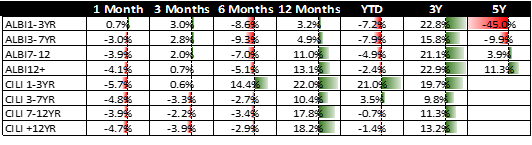
The tables below summarise the performance of major global and South African market indices, together with the performance of key currencies, across multiple time periods as at 31 July 2026.

Looking ahead, we see the artificial intelligence investment thesis becoming less forgiving. Investors are no longer asking only how fast demand might grow, but whether the huge sums being spent on chips, data centres and power can earn an adequate return. Revenues are rising, but so are capital expenditures, borrowings and competition. Cheaper and increasingly capable Chinese models make the question more pressing.
July’s take away is not that technology’s promise has disappeared, nor that every geopolitical shock must end badly. Rather, we are reminded that markets become increasingly fragile when too much confidence rests on one outcome. Diversification always matters most when it appears least necessary.
GOT A QUESTION?
If you would like to discuss how current market conditions may affect your portfolio, we will be happy to chat with you. Please contact your Plexus Wealth financial advisor to arrange a meeting.