

And in the blink of an eye, we have passed the halfway mark of 2026!
Global markets have been defined thus far by persistent AI hardware rallies, renewed conflicts disrupting energy markets, and shifting central bank interest rate policies. Major equity indices have remained buoyant, largely powered by tech earnings, even as geopolitical events introduced significant volatility.
GLOBAL MARKET UPDATE

The S&P 500 rose 5.23% in USD terms during May, marking a second consecutive month of strong positive returns. The rally was driven by improving risk sentiment, supported by optimism around a potential resolution to the Iran conflict, which contributed to a 17.46% decline in oil prices over the month. Emerging markets (+9.69%) outperformed developed markets (+4.55%), with both benefiting from continued enthusiasm around the semiconductor trade and a recovery in software stocks. The MSCI World Information Technology Index gained 15.96%, making it the best-performing sector in May. Within technology, Software & Services rose 15.98%, supported by improving sentiment following several positive company-specific data points and earnings updates. South Korea was the standout country performer, with the MSCI Korea Index advancing 35.29%, while Taiwan gained 16.53%, reflecting their significant exposure to the semiconductor supply chain. From a factor perspective, Momentum (+7.76%) and Growth (+6.99%) outperformed Quality (+3.71%) and Value (+2.27%), as investors rotated back into higher-growth areas of the market.
In June, US macroeconomic data pointed to a moderation in labour demand, while broader activity remained relatively resilient. The US economy added 57,000 jobs during the month, well below market expectations and down from a downwardly revised 129,000 in May, indicating a clear slowdown in hiring. The unemployment rate nevertheless declined from 4.3% to 4.2%, although this partly reflected a fall in labour-force participation rather than stronger employment growth. Wage growth remained firm, with average hourly earnings increasing by 0.3% month-on-month and 3.5% year-on-year, consistent with a labour market characterised by subdued hiring but still-limited layoffs. Headline CPI accelerated to 4.2% year-on-year in May, largely because of higher energy prices, while core inflation remained comparatively contained at 2.9%.
In June, the Federal Reserve maintained the federal funds target range at 3.50%–3.75% at Kevin Warsh’s first FOMC meeting as Chair. Policymakers acknowledged that economic activity remained solid but emphasised that inflation was still elevated, partly because of energy-related supply shocks associated with the Middle East conflict. The Fed’s updated projections reinforced a more hawkish policy outlook, with the median forecast for the federal funds rate at 3.8% at the end of 2026, compared with 3.4% in March, effectively removing expectations for near-term policy easing. Elsewhere, the European Central Bank raised its three key policy rates by 25 basis points, lifting the deposit facility rate to 2.25%, as higher energy prices intensified inflation risks. The Bank of England maintained Bank Rate at 3.75% by a 7–2 majority, reflecting continued concern that elevated energy costs could generate more persistent price and wage pressures.
LOCAL MARKET UPDATE
South African financial markets delivered a weaker performance in June, with the FTSE/JSE All Share Index declining by approximately 3.8% in ZAR terms over the month. The downturn was driven primarily by resource shares, with the Resources Index falling by approximately 15.9% as gold, platinum-group metal and broader commodity prices weakened. Gains in selected financial and industrial shares provided some support but were insufficient to offset the pronounced decline in the resource sector.
 South African bonds delivered a stronger performance in June as easing geopolitical tensions, rand recovery and continued confidence in the domestic fiscal outlook supported demand for government debt. The FTSE/JSE All Bond Index returned to positive territory for the year as bond yields declined from the elevated levels of the first quarter, with reduced fixed-rate government issuance and strong auction demand providing additional support. Headline consumer inflation rose to 4.5% year-on-year in May from 4.0% in April, driven primarily by higher fuel prices. Despite the acceleration in inflation and continued volatility in developed-market bond yields, South African fixed income remained underpinned by attractive nominal and real yields, relatively favourable domestic supply-and-demand dynamics and renewed investor appetite for emerging-market debt.
SARB rate increase
Governor Lesetja Kganyago defended the rate increase in May as a necessary response to the risk that higher oil, food and transport costs could generate broader second-round inflation effects. He cautioned that monetary policy could not prevent the initial impact of supply shocks but argued that the Bank had a responsibility to prevent temporary price increases from becoming embedded in wages, inflation expectations and general price-setting behaviour. Kganyago subsequently noted that inflation expectations had moved further away from the SARB’s 3% objective and reiterated that policymakers needed to act pre-emptively, given the lag with which monetary policy affects the economy.
The FTSE/JSE SA Listed Property Index (+3.3%) outperformed the All Share (-3.8%) in June, which was dragged down by Basic Materials (-16.0%). Outside of resources, property shared in broader strength across more cyclical, rate-sensitive sectors as easing geopolitical tensions supported a risk-on environment.
PLEXUS WEALTH PROPERTY VIEW
 The top three price performers in June were:
- Delta Property Fund (48.5%)
- Schroders European Real Estate Investment Trust PLC (14.3%)
- Heriot REIT (13.0%).
Delta’s share price saw a rally following Sahara Capital’s share purchase. Schroders’ rally was supported by the positive sentiment towards their proposed wind-down and return of capital. Heriot’s share price rose following the announcement of the approval of the approval of a share issue to related parties via a special resolution.
The bottom three funds were:
- Emira Property Fund (-7.1%),
- Texton Property Fund Ltd (-5.7%)
- Sirius Real Estate (-3.4%).
Despite no significant news or disclosures during the month, Emira’s share price declined materially. Texton’s share prices declined can largely be explained by limited liquidity.
Key points and trends for 2026 include:
- Fundamentals remain positive:
Listed property funds continue to deliver improved operational performance, supported by stronger rental income and dividend growth. These gains reflect continued self-help initiatives and better leasing activity amidst a tougher trading environment for listed property.
- Uptick in accelerated bookbuilds:
Various funds continue to raise capital from the equity market, which suggests the market is still largely constructive on the sector’s prospects and are looking beyond the current geopolitical strife.
- Interest rates uncertainty & inflation risk:
Following the extension of the initial ceasefire agreement between the US and Iran, brent crude softened to below $80 a barrel as shipping traffic in the Strait of Hormuz increased. This partial softening of inflationary pressures has split market sentiment on a further repo rate hike by the SARB and global growth expectations.
Over the short-term: The 10 year South African government bond yield rose slightly to 8.5% from a May print of 8.4%. It’s reasonable to assume yields will remain elevated relative to expectations at the start of the year if the uncertainty persists, deflating the sector’s valuations.
Looking further ahead: Should inflationary pressures re-emerge, there is a risk of further monetary policy tightening, which could increase both the cost of capital and borrowing costs. This, in turn, may weigh on distribution growth.
SECTOR RETURNS
 Global equities pulled back in June, giving up some of the ground gained over the prior two months. The MSCI World Index declined 0.7% for the month, with the pullback concentrated in mega-cap technology. US equities were among the weakest developed markets, with the S&P 500 down 1.0% as the “Magnificent Seven” fell roughly 10% and shed some USD 2.3 trillion in combined value, on signs that market leadership is broadening into value, financials, industrials and healthcare. Europe held up better, with the MSCI Europe ex UK Index up 1.3% in dollar terms, while the UK slipped 0.8% as the pound weakened against the dollar. Improving confidence that the US and Iran conflict is moving towards resolution supported broader sentiment, but coincided with a sharp pullback in precious metals, with the gold price falling 12% for the month, back towards USD 4,000/oz and down 25% from its January high, while platinum shed 19%.
South African equities bore the brunt of the precious metals sell off. In rand terms, the JSE Capped ALSI declined 3.7% for the month, its second consecutive negative month, pulling the index into negative territory for the first half of the year at -2.8%. Resources were the primary drag, with gold miners down 15% and platinum miners down 23% over the month as bullion and platinum prices retreated sharply. Financials and industrials were more resilient, with banks up around 3.0% and domestically focused shares up 3.4%, although weakness in index heavyweights Naspers and Prosus (down 4% in aggregate) weighed on the industrials sector.
ASSET ALLOCATION VIEWS
Summary:
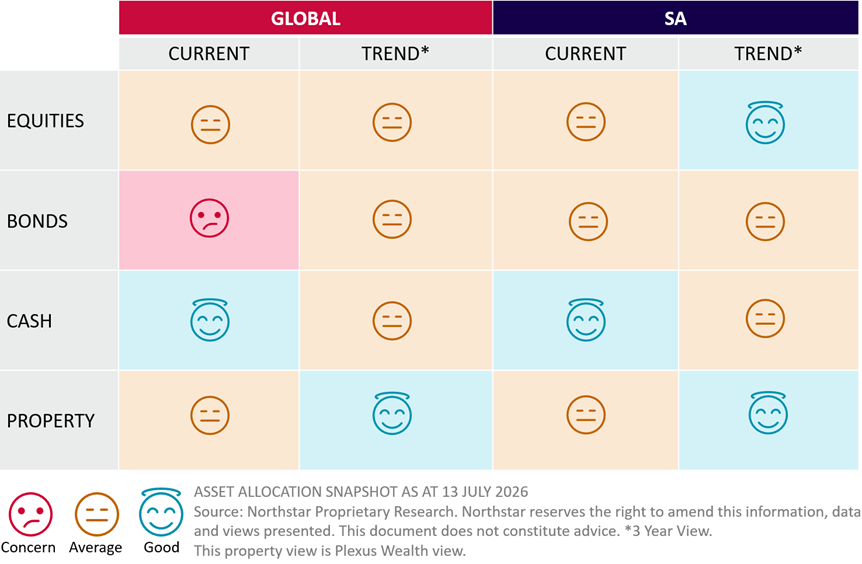
Details:
Global Equities
Current (Average)
June saw a broadening of market leadership away from the technology sector, although performance remained mixed beneath the surface. The MSCI World Information Technology Index declined 1.9%, with a sharp divergence within the sector – Semiconductors gained 5.1% as enthusiasm around the AI infrastructure build-out remained strong, while Software & Services reversed much of its May recovery, falling 14.2%. Health Care (+5.0%), Financials (+3.5%) and Industrials (+2.7%) delivered the strongest returns, while Communication Services (-8.0%), Energy (-6.1%), Materials (-5.6%) and Consumer Discretionary (-4.0%) lagged. Energy remained under pressure as Brent crude declined 19.9%, following an easing in geopolitical tensions and progress towards an interim agreement between the US and Iran.
Trend (Average)
At the index level, valuations remain elevated relative to long-term averages, while earnings expectations are still robust despite an uncertain rate outlook and ongoing geopolitical headwinds. Although market leadership broadened in June, earnings growth and investor enthusiasm remain concentrated in selected areas, particularly semiconductors and other beneficiaries of the AI investment cycle, raising questions about the durability of the current earnings base. Even so, the environment continues to offer selective opportunities for bottom-up investors. Capital remains heavily concentrated in a narrow group of growth themes, leaving several high-quality businesses trading at large discounts to their long-term earnings potential.
SA Equities
Current (Average)
Emerging markets softened in June despite the Strait of Hormuz tensions somewhat easing though June, with the MSCI EM down 1.7%. Locally, the JSE underperformed more sharply, falling 3.8%, driven by Basic Materials (-16.0%). Gold (-12.1%) and Brent crude (-19.9%) both reversed sharply in line with easing global tensions over June. Ex-resources, the picture was constructive. Consumer Discretionary (+7.2%), Food Producers (+7.0%) and Consumer Staples (+4.1%) led gains, with Banks (+3.1%) and Listed Property (+3.3%) also advancing reflecting a favourable risk on environment. The rand weakened modestly (-1.2%) against the dollar. With Basic Materials still up 38.1% over 12 months despite June’s reversal, the sector’s outsized weight in the index remains a key source of volatility for the JSE.
Trend (Good)
We remain overweight domestic SA Inc. equities on a risk-adjusted basis, with our valuation work supporting selective exposure to Banks, Industrials, and Retailers. Against a backdrop of gradual macro improvement and easing geopolitical tensions, we see attractive medium-term returns across these sectors. Within commodities, Gold and PGM counters have continued to pull back, and we will continue to be guided by our valuation work as opportunities open up in this space.
Global Bonds
Current (Concern)
Elevated geopolitical risk continues even as the 60 day fragile ceasefire takes effect. US and Iran are still exchanging fire and ship traffic through Hormuz is limited. With the oil price volatility, the trajectory of global inflation and path of interest rates have been upended. Bonds have sold off and could continue to come under pressure the longer the supply of oil remains hindered.
Trend (Average)
Over the longer term, the outlook remains largely intact: Sticky inflation, stable labour dynamics, rising growth forecasts and questions over the direction of the Fed under chairman Warsh, should keep yields elevated with the long-end most vulnerable to these pressures. A prolonged war in the Middle East will keep oil prices elevated and inflation concerns front of mind, causing volatility for yields at the short-end. The longer the conflict lasts, the more pronounced the feed through effects of a high oil price will be on the physical economy.
SA Bonds
Current (Average)
Local bonds saw some reprieve over June as geopolitical tensions eased. However, the situation remains uncertain and volatility may continue. That being said, local fiscal and macroeconomic indicators are relatively robust and may provide a cushion against the materialisation of global risks.
Trend (Average)
Despite the global uncertainty, positive structural elements remain in place for local bonds. Fiscal dynamics have improved and sovereign finances appear to be robust enough to weather global risks. The reform outlook is gaining credibility and has already led to multiple rating upgrades. The meaningful pull back in yields has provided for some opportunity at the front end of the curve, but longer out the curve appears fairly valued on our metrics.
Global Cash
Current (Good)
Over the near term, cash is the area providing the best protection against volatility. One can still generate a real return from cash, and any inflationary impulses would be combated with interest rate hikes from central banks, making cash more appealing on relative basis. Warsh has come out with more of a hawkish tone than expected and this could leave interest rates higher for longer.
Trend (Average)
On a three-year horizon, our valuation points to better opportunities in bonds across the curve versus what could be received for cash. However, volatility is likely to persist over the medium-term with debates about labour market weakness and rising inflation pressures creating uncertainty for where interest rates may settle.
SA Cash
Current (Good)
The materialisation of geopolitical risk will likely keep the SARB cautious, as recently noted by the governor. The MPC hiked rates by 25bps in May, with the Repo Rate up to 7.0%. The market is pricing a further two to three hikes of 25bps within the next year. Real rates remain elevated and current cash rates on offer are well above the inflation rate of 4.5%, therefore investors can still earn a healthy real return without taking on risk.
Trend (Average)
As inflation expectations move credibly lower over the medium, the SARB will become less restrictive and real rates will narrow, causing cash to become less competitive relative to other assets. It remains to be seen whether current geopolitical risks will be prolonged and to what extent the consequences stemming from elevated oil prices will filter into our longer term interest rate assumptions and cash valuations.
PLEXUS WEALTH FUND PERFORMANCE
Against this backdrop, the Plexus Wealth range of funds delivered the following performance for June 2026:
Plexus Wealth FundRock Conservative Fund:
+0.89% for June
+5.00% over the past quarter
+12.73% over the past 12 months.
Plexus Wealth FundRock Balanced Fund:
-0.86% for June
+2.93% over the past quarter
+10.00% over the past 12 months.
Plexus Wealth FundRock Property Fund:
+2.48% for June
+9.75% over the past quarter
+31.28% over the past 12 months.
Note: Boutique Collective Investments (BCI) has rebranded as FundRock Collective Investments (FundRock). This change aligns the South African business with its parent company, Apex Group, and its global FundRock brand. The change affects the fund name only and does not alter the investment strategy or fund objectives. If you have any questions regarding this change, please contact your Plexus Wealth financial adviser.
GLOBAL MARKET SNAPSHOT
The table below summarises the performance of major global and South African market indices, together with the performance of key currencies, across multiple time periods as at 30 June 2026.
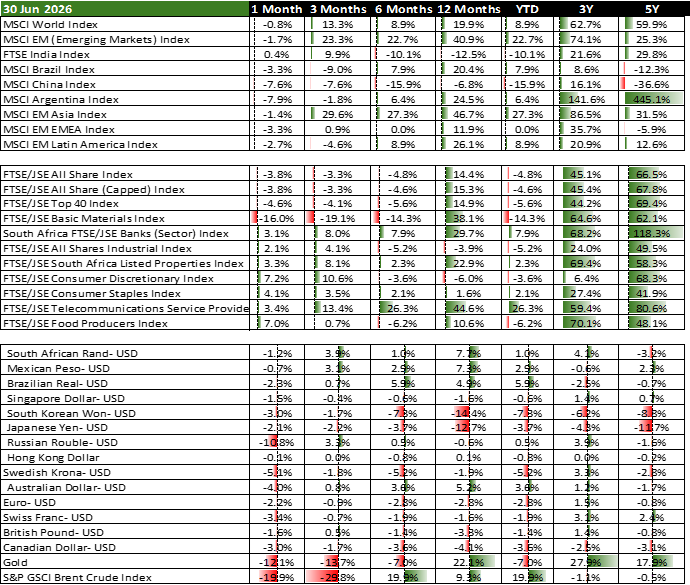
Looking forward, staying invested, diversified, and adaptable remains key. The global investment outlook remains constructive but selective – driven by resilient corporate earnings, robust capital spending in Artificial Intelligence (AI), and stable labour markets. Major institutions forecast continued equity gains. Key risks we continue to monitor include sticky energy-driven inflation, geopolitical tensions, and shifting central bank rate policies.
GOT A QUESTION?
If you would like to discuss how current market conditions may affect your portfolio, we will be happy to chat with you. Please contact your Plexus Wealth financial advisor to arrange a meeting.