

March was a bumpy month for markets, marked by heightened volatility across global markets. In this month’s report, we unpack the key developments and what they mean for portfolios and positioning going forward.
GLOBAL MARKET UPDATE
 March was characterised by a sharp risk-off move, largely driven by the escalation of tensions involving Iran. This led to a significant surge in energy prices, with oil rising 42.7%, and weighed on global growth expectations while exacerbating inflation concerns.
Most asset classes ended the month firmly in negative territory. Ten of the eleven global equity sectors declined materially, falling between 4% and 11%, with energy the sole outperformer, gaining 11.5%. Developed markets (-6.4%) proved more resilient than emerging markets (-13.1%), while within developed regions, the US (-5.0%) outperformed both Europe (-9.8%) and Asia (-12.0%).
Fixed income markets also came under pressure as inflation fears intensified. Expectations for interest rate cuts were largely priced out, with markets beginning to factor in the possibility of further rate hikes. In this environment, gold declined 10.8%, reflecting sensitivity to higher real yields.
Currency markets
Currency markets saw broad-based USD strength (+2.27%), with all major currencies weakening against the dollar.
Market volatility was amplified by heightened tensions around the Strait of Hormuz, where disruptions to shipping routes raised concerns over global energy supply security. The resulting oil price shock drove a sharp rally in crude prices, feeding into inflation expectations and reinforcing the broader risk‑off tone across global equity markets.
Macroeconomic data
In March, US macroeconomic data reinforced signs of a slowing but still resilient economy. The US added 178,000 jobs during the month, while the unemployment rate edged down to 4.3%, pointing to a labour market that remains uneven but has shown some stabilisation following prior disruptions. Inflation data came in below consensus expectations, with headline CPI rising 0.9% month over month and 3.3% year over year, as energy‑driven price pressures were partially offset by continued moderation in core components, with core CPI easing to 2.6% year over year.
The Federal Reserve held its March policy meeting and left rates unchanged, reiterating a data‑dependent approach and emphasizing that future adjustments would hinge on clearer evidence of sustained disinflation without a sharp deterioration in growth. Minutes from the meeting showed officials broadly comfortable maintaining restrictive policy for longer, while acknowledging that rate cuts later in the year remain possible should inflation continue to ease.
LOCAL MARKET UPDATE
South African financial markets delivered weak results over the month. The FTSE/JSE All Share Index declined by approximately 10.5% in ZAR terms for March, marking one of the sharpest monthly drawdowns in several years as heightened global risk aversion, rising energy prices and a pronounced sell‑off in resource stocks weighed on equity performance. Listed property also weakened, with the FTSE/JSE SA Listed Property Index declining by approximately 12.3% in ZAR terms for the month, as higher long‑bond yields and renewed inflation concerns drove a valuation reset across the sector.
The South African bond market experienced increased volatility over the month, with local fixed income coming under pressure amid rising global yields and heightened inflation risk linked to higher oil prices. While inflation data released during the period remained benign, headline consumer inflation eased slightly to 3.0% year on year in February (from 3.2% in January), this was increasingly viewed as a pre shock indicator given the material shift in the global inflation outlook during March.
Listed property
Listed properties strong momentum in 2026 was sharply reversed in March. As above the escalations in Middle East introduced renewed concerns around inflation, consumer affordability and path of interest rates. The index declining 11% over the month, compared with -7% for bonds, -10% for the All-Share Index and -10% for financials, while cash delivered 1%. By quarter-end, listed property had returned -5% for Q1, underperforming cash (2%) and bonds (-3%), and broadly tracking the weakness seen in risk assets more generally.
The SARB held a Monetary Policy Committee meeting in March, leaving the policy rate unchanged at 6.75% while adopting a cautious tone in response to elevated global uncertainty and rising inflation risks. Policymakers emphasised a data‑dependent approach, with market expectations for policy easing pushed further out as the impact of higher energy prices on the inflation trajectory comes into focus.
SECTOR RETURNS
Global equities corrected sharply in March as escalating geopolitical tensions in the Middle East weighed heavily on investor sentiment. The MSCI World Index declined by 6.3% for the month, with broad-based weakness across all major regions. Europe (-9.8%) and Asia Pacific (-11.2%) led the declines, while the US proved relatively more resilient, falling 5.6%. Emerging markets, which had outperformed on a year-to-date basis, also experienced a significant pullback, declining 13%, with particularly sharp losses in Korea, South Africa and the UAE. The sell-off reflects a shift in market focus toward rising energy prices, renewed inflationary risks, and increasing uncertainty around the timing of global rate cuts.
 Equities
South African equities came under significant pressure in March, reversing a portion of their recent strong gains. In rand terms, the JSE Capped ALSI declined 10.6%, driven primarily by a sharp sell-off in precious metal counters, particularly PGMs and gold equities.
This weakness was partially offset by strong gains in the energy and chemicals sectors, with Sasol, Exxaro and Glencore among the notable positive contributors. More defensive names such as Shoprite and BAT also provided relative support.
Despite the broad-based decline, the dispersion in returns across sectors highlights a market increasingly driven by stock-specific factors, with resource volatility remaining the dominant influence on near-term index performance.
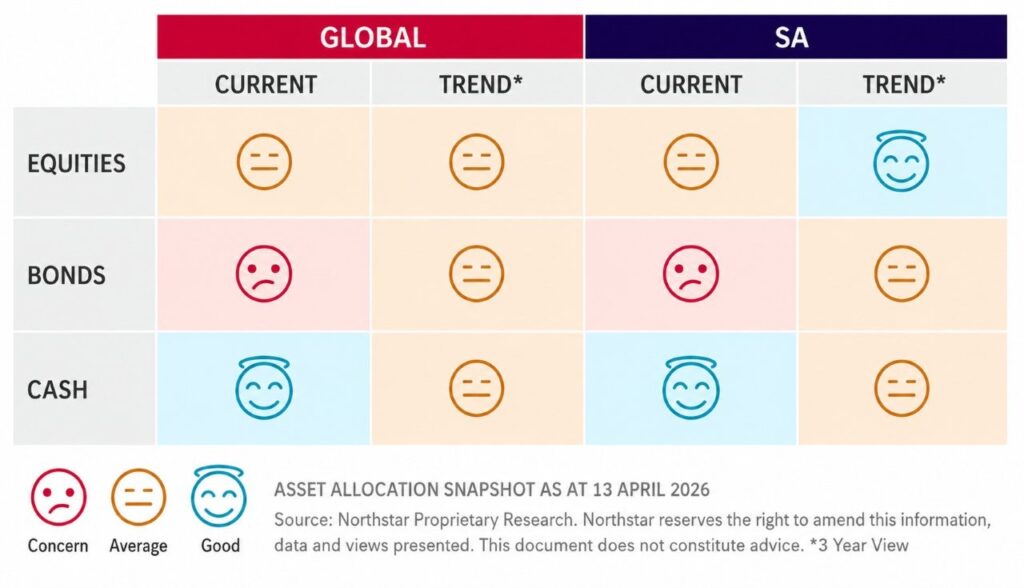
ASSET ALLOCATION VIEWS
DETAILS
Global Equities
Current (Average)
Returns were negative across asset classes in March, with both equities and bonds declining amid a broad-based risk-off environment. Energy was the sole positive sector, supported by a sharp rise in oil prices following the escalation in the Iran conflict, which triggered the largest supply shocks in global oil market history. Expectations for interest rate cuts have largely been priced out, with the potential for rate hikes now emerging. This shift in the rate outlook has begun to weigh on valuations and, if sustained, is likely to place additional pressure on earnings.
Trend (Average)
Despite the sharp drawdown during the month, year-to-date performance remains relatively resilient, with the MSCI World Index down 3.57% and the S&P 500 lower by 4.42%. Notably, earnings expectations for 2026 and 2027 remain robust, with mid-teens growth still being forecast despite the significant disruption to global energy markets and supply chains. This divergence highlights a key risk: current earnings expectations may not yet fully reflect the potential economic impact of sustained higher energy prices and supply-side constraints. Should these risks materialise more meaningfully, there is scope for further downside in equity markets. the USD could disrupt the current broadening of returns away from the US.
SA Equities
Current (Average)
The JSE came under pressure in March, declining 11.2%, broadly in line with the 13.3% fall in the MSCI Emerging Markets Index, as tensions in the Middle East escalated. Locally, losses were led by Basic Materials (-17.1%), driven by a 10.9% decline in the gold price in March. Interest rate-sensitive sectors also weakened, with Property (-11.8%), Consumer Discretionary (-11.3%) and Banks (-10.9%) all under pressure. The spike in oil prices raised concerns around higher inflation, weaker discretionary spending, and a reduced likelihood of interest rate cuts this year. More defensive areas of the market, with greater pricing power, held up relatively well, with Consumer Staples down 3.1% and Food Producers declining 6.5%. A prolonged conflict that further constrains oil supply would increase upside risks to inflation, placing additional pressure on consumers and delaying the prospect of rate cuts. In contrast, a shorter-term resolution would likely see these pressures ease, as the expectation and risk of sustained inflation would be eased.
Trend (Good)
Our valuation work continues to support a constructive view on local equities, with the March sell-off creating additional opportunities. We see upside in retailers, rand hedges and banks, however, given ongoing volatility in the Middle East, we remain mindful of the risks associated with a prolonged conflict. While gold and PGM stocks have pulled back, valuations appear broadly fair. Our medium-term outlook is underpinned by a continued structural recovery in the South African macro environment, which we expect to maintain momentum, while we continue to assess the potential impact of developments in the Middle East.
Global Bonds
Current (Concern)
The escalation of geopolitical risk materialised into US and Israeli airstrikes on Iran and the closure of the Strait of Hormuz. With the oil price spiking, the trajectory of global inflation and path of interest rates have been upended. Bonds have sold off and could continue to come under pressure the longer the supply of oil remains offline.
Trend (Average)
Sticky inflation, stable labour dynamics, rising growth forecasts and questions over Fed independence in 2026, should keep yields elevated with the long end most vulnerable to these pressures. A prolonged war in the Middle East will keep oil prices elevated, and inflation concerns front of mind.
SA Bonds
Current (Concern)
Local bonds stumbled in March as a global risk off environment followed from the US and Israel’s attack on Iran. Yields rose by over 100bps across the curve, with the front-end seeing most of the pain as the market reassess the interest rate path in light of a prolonged oil price shock. Bond valuations were stretched in February and susceptible to a sell off. Growing uncertainty and rising inflation risks are negative for local bonds over the short term.
Trend (Average)
Despite the recent sell off in local bonds, positive structural elements remain in place. Fiscal dynamics have improved, and sovereign finances appear to be robust enough to weather global risks. The reform outlook is gaining credibility and could necessitate multiple rating upgrades from the ratings agencies over the medium term. The meaningful pull back in yields has provided for some opportunity at the front end of the curve, but longer out the curve appears fairly valued on our metrics, moving back from overstretch levels that we saw in February.
Global Cash
Current (Good)
Over the near term, cash is the area providing the best protection against volatility. One can still generate a real return from cash, and any inflationary impulses would be combated with interest rate hikes from central banks, making cash more appealing on relative basis.
Trend (Average)
The Trump government is adamant on cutting interest rates but the Kevin Warsh nomination for Fed Chair stems previous concerns of rapid deterioration in Fed independence. Kevin Warsh is seen as someone with strong central bank experience, who will act with rationality when in the role of Fed Chair. Over the medium term, the debate between elevated inflation and labour market weakness is likely to rage on causing volatility an uncertainty at the short-end of the curve.
SA Cash
Current (Good)
The materialisation of geopolitical risk will likely keep the SARB cautious and may even lead to a rate hike in the near term. Further, real rates remain elevated as the SARB attempts to drive inflation expectations lower and maintain credibility. Current cash rates on offer are well above the inflation rate, therefore investors can earn a healthy real return without taking on risk.
Trend (Average)
As inflation expectations move credibly lower over the medium, the SARB will become less restrictive and real rates will narrow, causing cash to become less competitive relative to other assets. It remains to be seen whether current geopolitical risks will be prolonged and to what extent the consequences stemming from elevated oil prices will filter into our longer term interest rate assumptions and cash valuations.
PLEXUS WEALTH FUND PERFORMANCE
Against this backdrop, the Plexus Wealth range of funds delivered the following performance for March 2026:
Plexus Wealth BCI Conservative Fund:
-2.87% for the year to date
+12.46% over the past 12 months.
Plexus Wealth BCI Balanced Fund:
-4.10% for the year to date
+12.00% over the past 12 months.
Plexus Wealth BCI Property Fund:
-3.86% for the year to date*
+31.58% over the past 12 months*
* ranked 4th out of 36 peers
Our message to clients remains consistent: volatility is not a signal to retreat – it is the price of participation. As legendary investor Peter Lynch noted, markets typically decline by around 10% every two years and approximately 25% every six. These declines are inevitable, and the real risk lies not in the falls themselves, but in how investors respond to them.
When the urge to act is strongest, the most effective approach is often to stay diversified, stay invested, and stay patient. Markets have a way of recovering just when confidence is at its lowest.
GLOBAL MARKET SNAPSHOT
The table below summarises the performance of major global and South African market indices, together with the performance of key currencies, across multiple time periods as at 31 March 2026.


Looking ahead
In times like these, it is important to stay focused on long-term objectives and avoid being distracted by short-term market noise. We remain committed to navigating these conditions with a disciplined and considered approach, always with your best interests in mind.
GOT A QUESTION?
As always, we value the trust you place in us. If you have any questions, please do not hesitate to contact your financial advisor. We would also greatly appreciate any referrals of colleagues, friends or family who may benefit from our advice and approach.