

As we enter the final stretch of 2026 and with several key indices in Rands lagging cash, how will the remainder of the year play out and will investors be compensated for taking on risk in 2026?
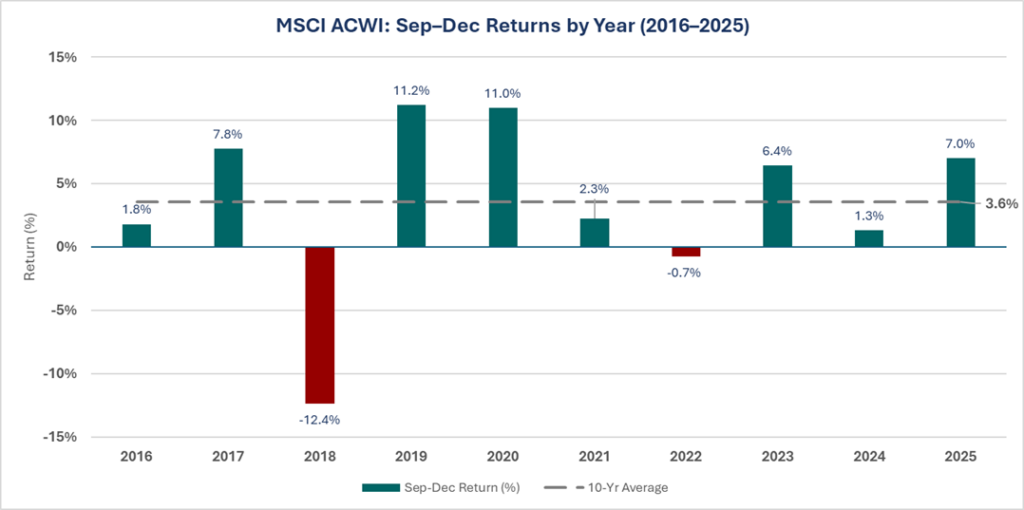
Although investing is a long-term commitment, the chart below suggests that the period from 1 September to 31 December has historically been profitable for investors. Despite renewed concerns about escalating conflict in the Middle East and rising bond yields globally, history suggests that risk assets tend to perform well during the final four months of the year.
The MSCI All Country World Index (ACWI), used here as a proxy for growth assets, has historically generated an average US dollar return of 3.6% over this four-month period between 2016 and 2025.
Global equities: historical performance during the final four months of each calendar year (2016- 2025)
GLOBAL MARKET UPDATE
Global equity markets regained momentum in August, with the MSCI World Index gaining 2.6% in US dollar terms following the relatively subdued return in July. Emerging markets performed slightly better, with the MSCI Emerging Markets Index rising 3.4%, while the MSCI ACWI gained 2.7%. Markets were supported by continued economic resilience and a healthy second-quarter corporate earnings season, despite ongoing uncertainty around interest rates and geopolitical risks. The S&P 500 gained 2.7%, while Japan rose 3.3% and Europe 1.4%.
 In August, US macroeconomic data showed some improvement in labour-market conditions, with nonfarm payrolls increasing by 162,000, following an upwardly revised gain of 21,000 in July. The unemployment rate remained unchanged at 4.1%, while labour-force participation edged higher to 61.6%. Wage growth remained moderate, with average hourly earnings increasing 0.3% month-on-month and 3.1% year-on-year, consistent with a labour market that remains relatively subdued despite the stronger headline employment gain. Inflation pressures continued to moderate in July, with headline CPI rising just 0.1% month-on-month and easing to 3.4% year-on-year, while core inflation increased 0.2% over the month and slowed to 2.5% year-on-year, suggesting that underlying price pressures remained relatively contained.
In August, attention at the Federal Reserve centred on Chair Kevin Warsh’s Jackson Hole address, where he emphasised that the US economy remained resilient and the labour market was broadly consistent with full employment, leaving inflation as the Fed’s predominant concern. Warsh noted that, despite some better-than-expected summer inflation readings, underlying price pressures had not improved sufficiently and reiterated that policymakers needed to be confident inflation was moving clearly and sustainably towards the 2% target. He also signalled a preference for less reliance on forward guidance and stressed that future policy decisions would remain driven by incoming data and underlying economic trends rather than a predetermined interest-rate path.
LOCAL MARKET UPDATE
South African equities delivered a strong performance in August, with the FTSE/JSE All Share Index gaining approximately 4.6% in ZAR terms and returning to positive territory for the year. The advance was driven overwhelmingly by resource shares, which surged approximately 23.5% as gold and platinum prices rallied strongly, with gold and platinum miners among the month’s best performers. In contrast, the broader market was considerably weaker, with industrials declining approximately 5.1% and financials falling around 1.6%, highlighting the narrow and commodity-driven nature of the equity market rally.
 South African bonds delivered a modest positive return in August, with the FTSE/JSE All Bond Index gaining approximately 0.7% as a stronger rand, improved foreign investor demand and softer domestic inflation supported the market. The 10-year government bond yield declined to around 8.5% early in the month before retracing to approximately 8.7%–8.8% by month-end, as renewed geopolitical tensions, higher oil prices and a more hawkish global interest-rate backdrop weighed on sentiment. Headline inflation eased more sharply than expected to 4.3% year-on-year in July from 5.0% in June, largely reflecting softer fuel-price pressures, although core inflation edged higher to 4.2%. Despite some late-month volatility, South African bonds remained supported by attractive nominal and real yields, a firmer rand and renewed foreign investor interest.
In the absence of an MPC meeting in August, attention remained focused on the SARB’s broader monetary-policy communication. Governor Lesetja Kganyago reiterated the importance of central-bank independence, inflation targeting and a flexible exchange rate in maintaining monetary credibility and supporting South Africa’s resilience to external shocks. He emphasised that credible monetary institutions have helped reduce inflation differentials, strengthen the country’s external position and lower risk premia over time.
SA Listed Property
SA Listed Property was the weakest-performing domestic asset class in August, declining 3.8%, compared with a 4.6% gain from the JSE Capped ALSI and a 0.7% return from the All-Bond Index. The sector gave back its July gains as investors rotated towards resources, with REITs declining 5.3% compared with a more modest 0.7% fall in real-estate investment and services companies. Despite the monthly weakness, SA Listed Property remained up 2.9% year to date. Valuations remain attractive and the prospect of lower medium-term funding costs remains supportive, although elevated fuel costs and pressure on discretionary consumption present risks for retail-focused landlords.
Top three share-price performers:
- Castleview Property Fund Ltd (9.0%)
- Emira Property Fund Ltd (2.3%)
- Fairvest Ltd B Shares (1.5%).
Despite no significant news or disclosures during the month, Castleview and Emira’s share prices appreciated materially, although Castleview’s liquidity remains limited.
Bottom three share-price performers:
- Primary Health Properties PLC (-8.9%)
- Growthpoint Properties Ltd (-7.2%)
- Vukile Property Fund (-6.9%).
Primary Health Properties’ share price declined materially despite an initially positive reaction to its retail shareholders’ presentation.
SECTOR RETURNS
 Global equity markets regained momentum in August, with broad-based gains across nearly every major asset class. The MSCI World Index returned 2.6% for the month in US dollar terms, while emerging markets outpaced developed peers with a 3.4% gain. The S&P 500 added 2.7% in local currency terms, Japan’s TOPIX rose 3.9%, and MSCI Emerging Markets Asia matched the broader EM gain at 3.4% in dollar terms. Growth and value stocks advanced in lockstep, both up 2.6%, while small caps outperformed with a 2.9% gain.
Materials was the standout global sector on the back of higher commodity prices, and technology shares recovered from July’s sell-off as another strong earnings result from Nvidia reinforced confidence in the AI investment cycle. Bond markets were more mixed, with the US yield curve flattening after a hawkish tone from Fed Chair Warsh at Jackson Hole, even as longer-dated yields eased on news of increased Treasury bond buybacks, while European yields rose on expectations of an ECB rate hike.
South African equities extended their strong run, with the JSE Capped SWIX returning 7.4% in US dollar terms and 4.6% in rand. The gains were narrowly concentrated, however, with Resources surging 24.5% while Industrials fell 5.6% and Financials slipped 1.6%. Aside from Healthcare, lifted by a 6.2% rebound in Aspen, every subsector outside Resources ended the month lower. Within Resources, Precious Metals led with a 32.2% gain and Industrial Metals rose 24.0%, as gold prices climbed around 10% for the month.
ASSET ALLOCATION VIEWS

DETAILS
Global Equities
Current (Average)
August provided further evidence of a broadening in market leadership, although the nature of the broadening changed from July. July had been characterised by a sharp reversal away from semiconductor and momentum leadership towards previously lagging areas of the market. In August, technology recovered strongly, but the gains were no longer concentrated solely in the semiconductor complex. Software & Services gained 14.0%, substantially outperforming Semiconductors at 4.2%, while Materials gained 9.7% and Healthcare 3.7%.
This suggests that investors are becoming more differentiated in how they assess the opportunities and risks associated with AI. Rather than treating technology as a single trade, performance is increasingly reflecting differences in earnings delivery, valuation and the perceived impact of AI on individual industries and business models. At the same time, strong commodity and materials performance demonstrates that market leadership is extending beyond technology altogether.
The performance of defensive sectors was more mixed than in July. Healthcare remained relatively strong, but Consumer Staples declined 1.2%, Utilities fell 3.2% and Real Estate declined 2.1%. Rising bond yields and renewed uncertainty regarding the direction of monetary policy weighed on these more rate-sensitive areas. Fed Chair Kevin Warsh maintained a hawkish stance at Jackson Hole, while longer-term government bond yields remained elevated despite the Treasury’s planned increase in long-dated bond purchases.
Trend (Average)
August reinforces the view that the exceptional concentration of returns seen in the second quarter may be beginning to moderate. July initially looked like a reversal of the AI and semiconductor trade, but August suggests the picture is more nuanced: semiconductor shares recovered, software kept outperforming strongly, and Materials emerged as the best-performing sector. The market therefore appears to be broadening its leadership rather than simply rotating from growth into value.
This is also evident in investment-style performance, where Growth and Value delivered almost identical returns in August after July’s extreme factor dispersion, when Momentum fell sharply and Value materially outperformed. Quality and Momentum also generated positive returns, while emerging markets outperformed developed markets, Taiwan and Korea recovered strongly, and commodity-sensitive markets such as South Africa benefited from higher precious-metal prices.
At the index level, valuations remain elevated relative to long-term averages and earnings expectations remain robust. Strong corporate earnings and resilient economic activity continue to provide fundamental support for equities, but the macroeconomic backdrop has become more complicated. Higher bond yields, persistent inflation concerns and geopolitical uncertainty remain important risks, while the rally in gold and other commodities highlights ongoing concerns around fiscal sustainability and monetary credibility.
Overall, August was constructive in that returns became less dependent on a narrow group of semiconductor companies, with strength spread across software, materials, healthcare and parts of emerging markets as the momentum-driven concentration seen earlier in the year continued to ease. While it’s too early to call this a permanent shift in market leadership, broader earnings participation and greater differentiation between companies point to a healthier environment for fundamentally driven investors.
SA Equities
Current (Average)
Emerging markets strengthened in August, with the MSCI EM up 3.2%. Locally, the JSE outperformed, rising 4.3%, although the headline return masked a highly uneven underlying market. Basic Materials surged 24.1%, more than offsetting broad-based weakness across domestically exposed sectors. Industrials (-5.7%), Telecommunications (-7.2%), Consumer Discretionary (-4.1%), Consumer Staples (-4.1%) and Food Producers (-4.5%) all declined, while Banks fell 1.9% and Listed Property lost 3.9%. The rand strengthened 2.6% against the dollar. August therefore reflected a narrow, resource-led market rather than broad-based strength, with domestic sectors generally remaining under pressure.
Trend (Good)
We remain overweight domestic SA Inc. equities on a risk-adjusted basis, with our valuation work continuing to support selective exposure to Banks, Industrials and Retailers. These areas have come under meaningful pressure as high interest rates and elevated oil prices have weighed on inflation and consumer health, but valuations are now discounting a relatively stressed outcome. We see attractive medium-term return potential as conditions normalise, while continuing to be guided by bottom-up valuation discipline in determining where the risk-reward remains most compelling.
Global Bonds
Current (Concern)
US and Iran are still exchanging tit-for-tat fire and ship traffic through Hormuz is limited, with no deal in sight. With the oil price volatility, the trajectory of global inflation and path of interest rates remain uncertain. Global bonds have sold off in August and will continue to come under pressure the longer the supply of oil remains hindered. A Hawkish Fed and renewed concerns around global sovereign debt levels has added additional upward pressure on yields.
Trend (Average)
Over the longer term, the outlook remains largely intact: Sticky inflation, stable labour dynamics and rising growth forecasts should keep yields elevated with the long-end most vulnerable to these pressures. A prolonged war in the Middle East will keep oil prices elevated and inflation concerns front of mind, causing volatility for yields at the short-end.
SA Bonds
Current (Average)
Local bonds saw continued pressure in August as geopolitical tensions whiplashed. The situation remains uncertain and volatility has continued. However, local fiscal and macroeconomic data points still reflect reletively strength that has provided a cushion against the materialisation of global risks.
Trend (Average)
Despite the continued global uncertainty, positive structural elements remain in place for local bonds. Fiscal dynamics have improved and sovereign finances appear to be robust enough to weather global risks. The key risk lies with whether the SARB can meet its 3% inflation target goal into 2028 and if the National Treasury can continue delivering on fiscal consolidation.
Global Cash
Current (Good)
Over the near term, cash is the area providing the best protection against volatility. One can still generate a real return from cash like instruments, and any inflationary impulses would be combated with interest rate hikes from central banks, making cash more appealing on relative basis.
Trend (Average)
On a three-year horizon, our valuation points to better opportunities in bonds across the curve versus what could be received for cash. However, volatility is likely to persist over the medium-term with debates about labour market strength and rising inflation pressures creating uncertainty for where interest rates may settle over the medium term.
SA Cash
Current (Good)
The materialisation of geopolitical risks will keep the SARB cautious, as recently noted by the governor. The MPC will meet at the end of September, with what will likely be a close call for a hike or hold on the Repo Rate. The market continues to price a further two hikes of 25bps within the next year. Real rates remain elevated and current cash rates on offer are well above the inflation rate of 4.3%, therefore investors can still earn a healthy real return without taking on risk.
Trend (Average)
As inflation expectations move credibly lower over the medium, the SARB will become less restrictive and real rates will narrow, causing cash to become less competitive relative to other assets. It remains to be seen whether current geopolitical risks will be prolonged and to what extent the consequences stemming from elevated oil prices will filter into our longer term interest rate assumptions and cash valuations.
PLEXUS WEALTH FUND PERFORMANCE
Against this backdrop, the Plexus Wealth range of funds delivered the following performance for August 2026:
Plexus Wealth FundRock Conservative Fund:
+0.33% for August
+3.26% for the year to date
+10.10% over the past 12 months.
Plexus Wealth FundRock Balanced Fund:
+1.16% for August
+2.76% for the year to date
+10.01% over the past 12 months.
Plexus Wealth FundRock Property Fund:
-3.50% for August
+3.13% for the year to date
+20.64% over the past 12 months.
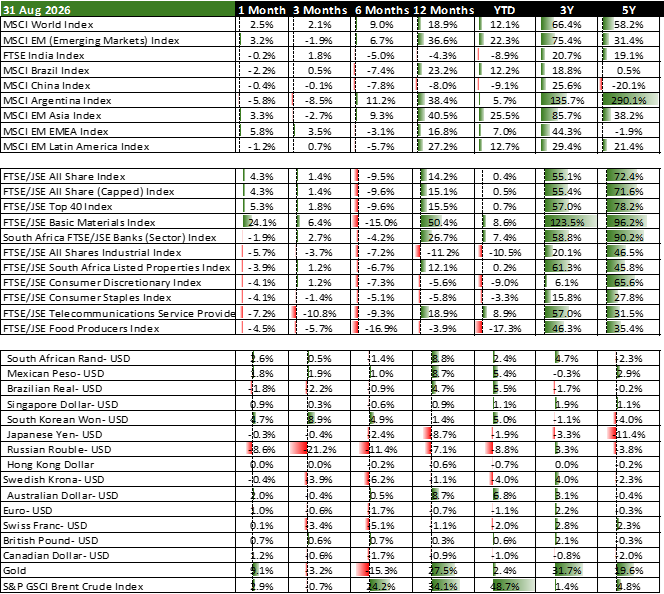
GLOBAL MARKET SNAPSHOT
The tables below summarise the performance of major global and South African market indices, together with the performance of key currencies, across multiple time periods as at 31 August 2026.

In summary, global markets appear to face a complex final four months of 2026, driven by rising bond yields, hawkish central banks, and energy price volatility.
Locally, the outlook is defined by cautious optimism. While the broader global markets face volatility due to restrictive interest rates and Middle East tensions, the FTSE/JSE All Share Index is proving resilient, trading at attractive forward valuations well below its historic averages.
GOT A QUESTION?
If you would like to discuss how current market conditions may affect your portfolio, we will be happy to chat with you. Please contact your Plexus Wealth financial advisor to arrange a meeting.
Recent Comments