

August’s broad-based recovery gave way to a more uneven market environment in September. The United States Federal Reserve (Fed) announced its first interest rate hike in more than three years, while a renewed breakdown in Strait of Hormuz diplomacy and the high-profile launch of Meta’s Muse – billed as the world’s first personal artificial intelligence (AI) agent – pulled markets in competing directions. As a result, September’s gains were concentrated in technology and growth orientated markets, while rate sensitive and commodity importing regions came under pressure. The month ended with geopolitical risk intensifying, bond markets flashing recession warnings and monetary policy tightening on multiple fronts.
On a brighter note, global stocks have performed better following rate HIKES than rate CUTS since 1982. The reason is simple: rate hikes typically occur when an economy is in expansion, when corporate earnings are rising. That’s certainly true today, with S&P 500 earnings to rise 34% in 2026, up 15% at the start of the year.

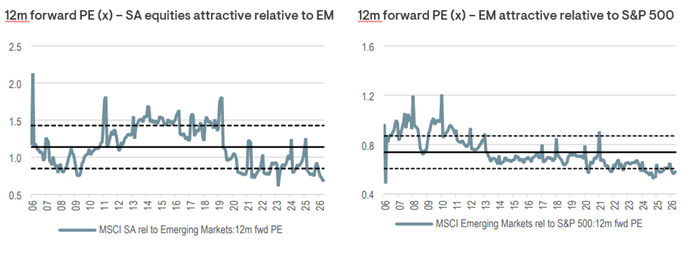
Another reason for optimism is the extreme value on offer in South African mid- and small caps, as illustrated by the charts below. To quote John Biccard, arguably South Africa’s most renowned value manager “SA equities are on record low valuations and South African mid and small caps are among the cheapest equities in the world. We are all-in.”
The charts below illustrate the attractiveness of Emerging Market equities relative to the S&P 500 (right-hand chart) and South African equities relative to EM (left-hand chart). In short, EM equities are the cheapest they’ve been since 2006 relative to US equities, as are SA equities relative to EM equities.
GLOBAL MARKET UPDATE
 Global equities weakened in September as higher oil prices and a surge in bond yields weighed on markets. Brent crude gained 8.3%, while the US 10-year Treasury yield rose by over 50 basis points to 5.29% over the month. While renewed strength in AI-related shares and momentum cushioned broader weakness, the MSCI World Index fell 1.2% in US dollar terms over the month. The S&P 500 declined just 0.3%, Japan gained 1.5%, and emerging markets fell 0.6%, supported by gains in South Korea (+3.2%) and Taiwan (+4.2%). Elsewhere, losses were more pronounced, with US small caps falling 5.3%, Europe down 4.6%, and the UK declining 4.0%.
In September, the Federal Reserve delivered its first rate hike since 2023, raising the target range 25 basis points to 3.75%–4.00%. Chair Kevin Warsh characterised the move as “removing accommodation” rather than tightening, reiterating that price stability remains the Fed’s predominant focus and that policymakers needed to be confident inflation was moving clearly and sustainably towards the 2% target. The accompanying dot plot was notably hawkish, lifting the median 2026/2027 rate projection to 4.125%, around 50 basis points higher than in June. He again signalled a preference for less reliance on forward guidance, stressing that future policy decisions would remain driven by incoming data and underlying economic trends rather than a predetermined interest-rate path.
LOCAL MARKET UPDATE
South African equities retreated sharply in September, with the FTSE/JSE Capped All Share Index falling approximately 5.8% and slipping back into negative territory for the year. The decline was led by precious-metal miners: gold miners fell approximately 15% and platinum miners around 7% as gold and platinum prices weakened. Domestic economy stocks also came under pressure, declining approximately 3.3%, although general retailers were a notable exception, gaining around 5%. The month’s reversal erased much of August’s rally and left the market’s performance highly sensitive to precious-metal prices.
 South African bonds delivered a broadly flat return in September, with the FTSE/JSE All Bond Index Total Return gaining just 0.01% over the month as the 10-year government bond yield declined to around 8.75% before backing up sharply toward 9% into month-end. The SARB unanimously raised the repo rate 25 basis points to 7.25% against a more hawkish global rate backdrop, firmer oil prices and renewed Middle East tensions weighed on sentiment. Headline inflation edged up to 4.4% year-on-year in August from 4.3% in July, still below consensus but driven mainly by an 8.8% rise in transport costs and firmer electricity and fuel prices, even as core inflation eased slightly to 4.1%. The 10-year government bond yield lagged with a -0.33% total return while front dated linkers turned positive as elevated fuel-driven inflation expectations provided support. Despite the late-month volatility, South African bonds remained supported by attractive nominal and real yields and the rand’s continued structural resilience, even as it eased toward R16.70/$ by early October amid broad US dollar strength and Brent crude holding above $100 a barrel.
The SARB raised the Repo Rate by 25 basis points to 7.25% (prime to 10.75%). SARB Governor Lesetja Kganyago characterised the backdrop as “a large, negative and persistent global supply shock,” citing an escalation of the Middle East conflict, fighting in Yemen disrupting Saudi oil exports, and Russia-Ukraine-related damage to refinery capacity. Headline inflation is now expected to exceed 5% later this year and into early 2027 on higher fuel prices, before easing back toward 3% by the end of 2027, while the 2026 growth forecast was trimmed to 1.2% after the economy contracted 0.2% in the second quarter. Decisions will continue to be taken meeting by meeting, with the Bank’s own forecast model pointing to a broadly stable policy rate into year-end.
SA LISTED PROPERTY
 SA Listed Property was one of the few positive domestic asset classes in September, returning 0.5%, compared with a 5.8% decline in the JSE Capped ALSI and a flat return from the All-Bond Index. The sector was relatively resilient during the equity sell-off: REITs gained 0.3%, while real-estate investment and services companies rose 0.1%. SA Listed Property remained up 3.4% year to date. Valuations remain attractive and the prospect of lower medium-term funding costs remains supportive, although September’s rate increase and higher bond yields highlight near-term funding risks. Elevated fuel costs also remain a risk for retail-focused landlords through pressure on discretionary spending.
Top three top three share-price performers in September:
- Newpark REIT Ltd (10.6%)
- Dipula Properties Ltd (8.2%)
- Attacq Ltd (7.8%).
Newpark Reit’s share price rose sharply following the announcement of their voluntary share repurchase. While the share price performance of Dipula and Attacq was supported by favourable market reactions to their pre-close and full-year results announcements, respectively.
Bottom three performers:
- Delta Property Fund Ltd (-15.0%)
- Sirius Real Estate Ltd (-9.2%)
- Accelerate Property Fund Ltd (-9.1%).
Despite no significant news or disclosures during the month, Delta’s share prices depreciated materially. Sirius’ share price weakness can be explained by the rising global bond yields.
SECTOR RETURNS
Global equities delivered modest gains in the third quarter, with the MSCI World Index rising 2.0% in US dollar terms, while emerging markets slightly underperformed as the MSCI EM Index slipped 0.2%. Over 12 months, however, emerging markets remained well ahead, returning 29.6% against 15.3% for developed markets. Japan (+6.1%) and China (+3.7%) led regionally, while Europe declined 1.6%. Commodities rebounded, led by energy, with Brent crude up 42% to around USD104 per barrel. Higher bond yields and renewed tensions in the Middle East weighed on sentiment as the quarter progressed.
South African equities were broadly flat, with the JSE Capped SWIX declining 0.3% in rand terms. The headline return masked a sharp divergence between sectors, with Resources gaining 15% while Financials fell 3% and Industrials declined 10%. Within Resources, Industrial Metals rose 35% and Precious Metals 17%, as copper gained 9%, platinum 10% and gold 3%. Higher oil prices, rising bond yields and the SARB’s 25 basis point rate hike weighed on the market later in the quarter.
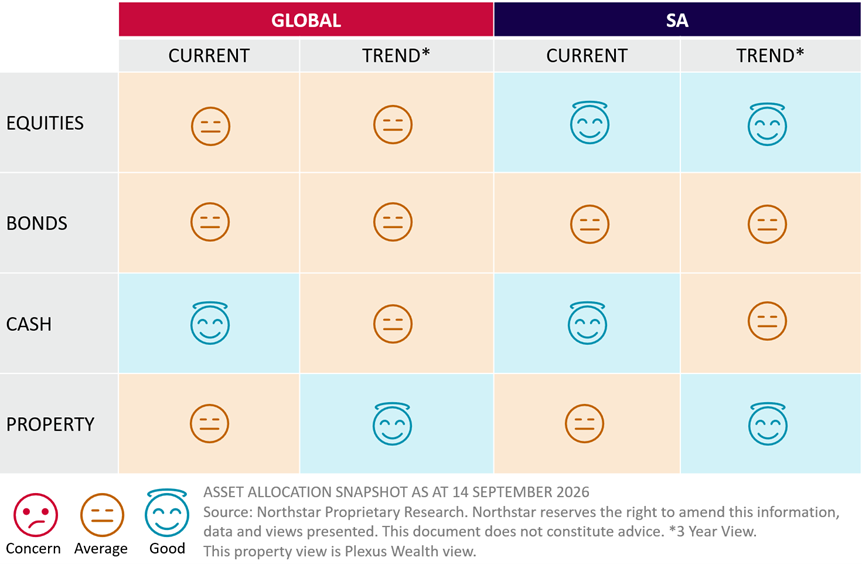
ASSET ALLOCATION VIEWS
DETAILS
Global Equities
Current (Average)
September’s modest index decline masked broader weakness, with nine of the eleven global equity sectors ending the month lower. Materials (-7.3%), Real Estate (-6.2%) and Consumer Discretionary (-6.0%) were the weakest performers, while Financials fell 5.5% and Utilities declined 5.1%. Higher bond yields weighed on rate-sensitive sectors, while rising energy costs added pressure to the outlook for consumer spending and company margins. Information Technology (+4.4%) and Communication Services (+3.5%) were the exceptions. The launch and rapid adoption of Meta’s Muse AI agent renewed enthusiasm for the infrastructure needed to support AI, lifting semiconductor and technology hardware shares and reversing some of their earlier weakness. The MSCI World Semiconductor Index gained 7.2%, although it remained down 3.0% over the quarter. Momentum also recovered, returning 3.6%, while Value declined 2.3%. September therefore interrupted the broadening seen in recent months, with market resilience again concentrated in a relatively narrow group of AI-related businesses.
Trend (Average)
Index valuations and growth expectations remain elevated, with much of the optimism concentrated in AI-related businesses. Strong earnings and growing adoption, including Muse’s early success, support this theme. However, the sustainability of infrastructure investment and the extent to which future growth is already reflected in share prices remain key uncertainties. Across the broader market, higher oil prices and bond yields pose risks to household spending, company margins and valuations. These macroeconomic concerns, combined with capital favouring a narrow group of AI beneficiaries, are leaving some high-quality businesses overlooked and trading at more attractive valuations, creating selective long-term opportunities.
SA Equities
Current (Good)
Emerging markets weakened in September, with the MSCI EM falling 0.5% in US dollar terms. Locally, the JSE declined 5.8%, reversing August’s gains, as weakness spread across most sectors. Basic Materials fell 9.4%, while Industrials (-4.9%), Telecommunications (-4.9%), Consumer Discretionary (-6.1%), Food Producers (-6.5%) and Banks (-4.2%) also declined. Consumer Staples fell by a more modest 0.6%, while listed property edged up 0.5%. The rand weakened 1.6% against the dollar. September therefore marked a broad-based reversal, with even the resource-heavy market under pressure.
Trend (Good)
We remain overweight domestic SA Inc. equities on a risk-adjusted basis, with our valuation work continuing to support selective exposure to Banks, Industrials and Retailers. These areas have come under meaningful pressure as high interest rates and elevated oil prices have weighed on inflation and consumer health, but valuations are now discounting a relatively stressed outcome. We see attractive medium-term return potential as conditions normalise, while continuing to be guided by bottom-up valuation discipline in determining where the risk-reward remains most compelling.
Global Bonds
Current (Average)
US-Iran tensions escalated sharply in September with no ceasefire or active negotiations in sight. Oil shipping through Hormuz remains severely limited, and Brent crude pushed back above $100 a barrel, with US diesel prices hitting a fresh record above $5.94/gallon. The Fed delivered its first hike since 2023, raising the target range 25 basis points to 3.75%–4.00%, with a hawkish dot plot lifting the median 2026/2027 rate projection to 4.125%, about 50 basis points higher than in June, as the new chair framed the move as “removing accommodation” rather than tightening, with price stability the “predominant focus.” Global bonds sold off further as a result: the US 10-year yield rose roughly 53 basis points over the month to 5.28%, and the iShares Global Aggregate Bond proxy (GLAG) fell approximately 2.2%.
Trend (Average)
Over the longer term, the outlook remains largely intact: sticky inflation, a cooling but still-resilient labour market and upwardly-revised growth forecasts should keep yields elevated, with the long end most vulnerable to these pressures. A prolonged war in the Middle East will keep oil prices elevated and inflation concerns front of mind, causing continued volatility for yields at the short end.
SA Bonds
Current (Average)
Local bonds saw renewed volatility in September as a SARB rate hike, firmer oil prices and persistent Middle East tensions weighed on sentiment into month-end. The situation remains uncertain, but local fiscal and macroeconomic data points continued to reflect relative strength, providing a cushion against the broader deterioration in global risk appetite.
Trend (Average)
Despite the continued global uncertainty, positive structural elements remain supportive of local bonds. Sovereign credit risk continues to price favourably against the US, with credit-default-swap spreads having narrowed meaningfully this year. The key risk lies with whether the SARB can hold its inflation forecast path (it now expects headline inflation above 5% in late 2026 and early 2027 before easing back toward 3% by late 2027) and whether National Treasury can continue delivering on fiscal consolidation, as markets price in roughly two further SARB hikes over the next six months.
Global Cash
Current (Good)
Over the near term, cash remains the area providing the best protection against volatility. Real cash returns have, if anything, improved following September’s hike, and any further inflationary impulses would continue to be combated with interest rate hikes from central banks, keeping cash appealing on a relative basis.
Trend (Average)
On a three-year horizon, our valuation still points to better opportunities in bonds across the curve versus what could be received for cash. However, volatility is likely to persist over the medium term: September’s sharply weaker payrolls print sits uneasily alongside a pickup in headline inflation, keeping the debate about labour market strength versus rising inflation pressures very much alive.
SA Cash
Current (Good)
Geopolitical risks kept the SARB on a cautious, restrictive footing in September. The MPC delivered the widely-expected 25 basis point hike to the Repo Rate, taking it to 7.25%. The market continues to price a further two hikes of 25bps within the next six months. Real rates remain elevated and current cash rates on offer are well above the inflation rate of 4.4%, therefore investors can still earn a healthy real return without taking on risk.
Trend (Average)
If inflation expectations move credibly lower over the medium term, the SARB is expected to become less restrictive and real rates will narrow, causing cash to become less competitive relative to other assets. It remains to be seen whether current geopolitical risks will be prolonged and to what extent the consequences stemming from elevated oil prices will filter into our longer-term interest rate assumptions and cash valuations.
PLEXUS WEALTH FR FUND PERFORMANCE
Against this backdrop, the Plexus Wealth FR range of funds delivered the following performance for September 2026:
Plexus Wealth FundRock Conservative Fund:
-1,48% for September
+1,73% for the year to date
8,34% over the past 12 months.
Plexus Wealth FundRock Balanced Fund:
-4% for September
-1,35% for the year to date
5,44% over the past 12 months.
Plexus Wealth FundRock Property Fund:
– 0,29% for September
+2,83% for the year to date
+21,62% over the past 12 months.
GLOBAL MARKET SNAPSHOT
The tables below summarise the performance of major global and South African market indices, together with the performance of key currencies, across multiple time periods as at 30 September 2026.
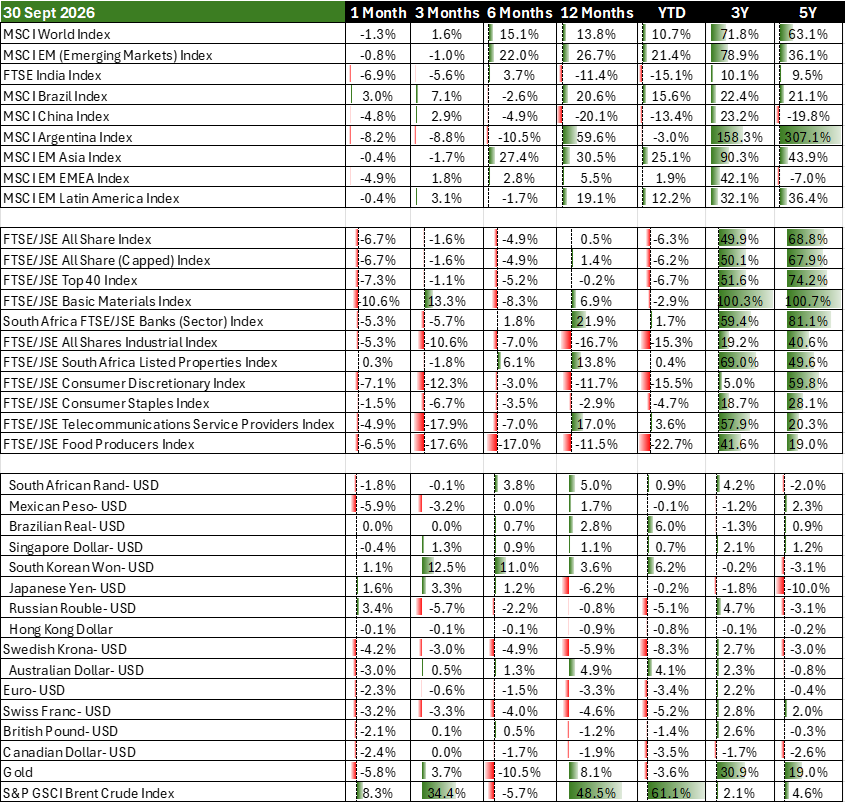
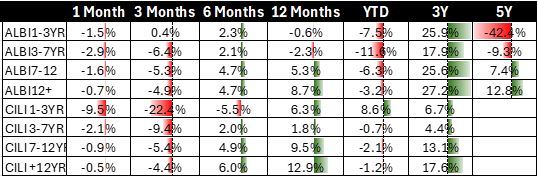
In summary, according to the International Monetary Fund’s October 2026 World Economic outlook, the global economy continues to show resilience with a projected 3.1% GDP growth rate for 2026. However, this is closely balanced against rising long term bond yields and persistence geopolitical risk. On the local front we are encouraged by the deep discount in select equities and how best we can exploit those opportunities for our clients.
GOT A QUESTION?
If you would like to discuss how current market conditions may affect your portfolio, we will be happy to chat with you. Please contact your Plexus Wealth financial advisor to arrange a meeting.
Recent Comments